
Refunds4 min read
How automatic refunds work
Updated
If a swap cannot complete, the deposit goes back on its own. Here is where it goes, how much you get back, and when a refund address is required.
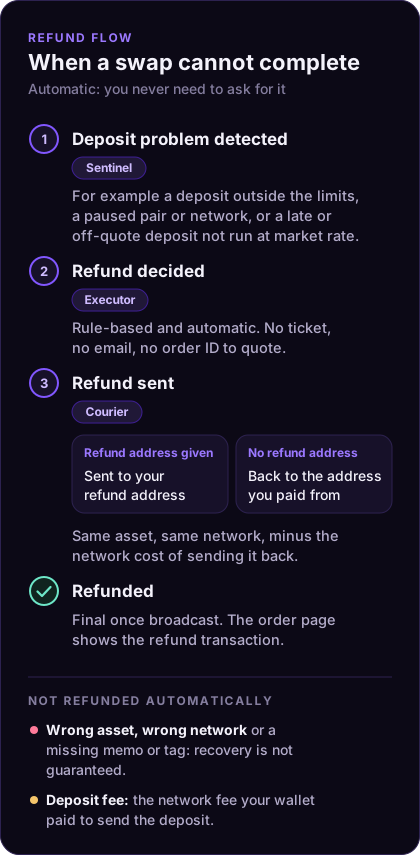
Refunds on Ghostex are automatic. When a swap cannot complete, for example because the deposit is below the minimum or the pair was paused, Executor decides the refund. Courier then sends it to your refund address or, if you gave none, back to the address you paid from. It comes back in the same asset and on the same network, minus the network cost of sending it.
Every confirmed deposit ends one of two ways: delivered, or refunded automatically
A refund is not a special case that needs chasing. It is the second normal outcome, and it runs on its own. A published refund rule is also one of the points on our checklist for the question is a no-KYC exchange safe.
You never open a ticket, send an email or quote an order ID to get a refund. If a swap cannot complete, the agents send the deposit back without being asked. Other services set their own rules: Exolix's terms (checked 26 September 2026) ask you to report a client error before the payout goes out. Our Exolix alternative page compares the two refund rules; Ghostex is not affiliated with Exolix.
Which agents handle a refund?
Three of the five AI agents carry a refund from start to finish. Sentinel detects the exception, for example a deposit outside the limits or a paused pair. Executor decides the refund and prepares it. Courier signs the refund transaction and broadcasts it on the network you paid on.
- Sentinel, the chain-watch agent: spots the exception.
- Executor, the settlement agent: turns the order into a refund.
- Courier, the payout agent: sends the refund on-chain.
You can follow what each agent does at every step in what happens during a crypto swap.
Where does a refund go?
A refund goes to your refund address if you gave one, or else back to the address you paid from. It always comes in the same asset and on the same network as your deposit:
- If you gave a refund address, the deposit goes there.
- If you did not, it goes back to the address the deposit was sent from, on the same network.
It is never paid in the asset you were trying to buy, and you do not have to do anything to make it happen.
When is a refund address required?
Some payments do not reveal a sending address, so there is no fallback to refund to. For these assets, a refund address is required when you create the order:
- Monero (XMR), whose ring signatures sign each spend together with other outputs pulled from the blockchain. An outside observer cannot tell which of them belongs to the sender.
- Bitcoin over Lightning, which is paid to an invoice. The fields of a Lightning invoice describe the payment and the payee, such as the amount, the expiry time and the payee's node key. None of them names the payer.
- Zcash (ZEC), when the transfer is shielded. Shielded Zcash addresses keep financial information private, while transparent addresses make it public.
For every other asset a refund address is optional, because the sending address is visible on the public chain and can serve as the fallback. Monero, Bitcoin over Lightning and Zcash can only be received on Ghostex today, not sent, so no pair available now requires a refund address.
Paying from an exchange account
If you fund a swap from an exchange account or another shared, custodial address, a refund without a refund address goes back to that shared address. Whether it is then credited to you is up to that service, and some do not credit deposits they did not expect. The safe habit is to add your own refund address when you pay from an exchange, so a refund reaches you directly.
How much comes back?
A refund is the amount received, minus the network cost of sending it back. For example, 0.0500 BTC received comes back as 0.0500 BTC minus the network cost of sending it back. With an illustrative network cost of 0.00002 BTC (2,000 satoshis), that is 0.04998 BTC; the real cost depends on the fee rate on the network when the refund is sent. The fee your wallet paid to send it is not refunded, because it was already spent on the network. A refund is final once broadcast, just like a payout. Fees are covered in more depth in network fees on a crypto swap.
Timing, and how to check a refund
A refund is broadcast once Executor decides it and Courier signs it, which is usually quick after the exception is detected. Most of any wait is the network confirming, exactly as with a normal payout. To follow it, open your order page: the status moves to Refunded, and the timeline shows the refund transaction alongside the agent that handled each step. Where the network has a public explorer, the order links to it so you can watch the refund confirm.
Other services time refunds differently. SimpleSwap's terms (checked 26 September 2026) treat a refund as a request that its support processes within up to 31 calendar days. Our SimpleSwap alternative page compares the two refund rules; Ghostex is not affiliated with SimpleSwap.
What triggers a refund?
Refunds cover the ordinary edge cases: a deposit below the minimum or above the maximum, or an amount that does not match a fixed rate. The same applies when a pair or network is paused before execution, or when an interruption is one the order cannot ride out. Sending the exact quoted amount avoids most of them. See why to send the exact amount.
The table sums up each case. Every automatic refund is paid in the same asset and on the same network as the deposit.
| Trigger | Where it goes | How much comes back |
|---|---|---|
| Deposit below the minimum or above the maximum | Your refund address, or else the address you paid from | The amount received, minus the network cost of sending it back |
| Different amount or late deposit on a fixed rate, not executed at the market rate | Your refund address, or else the address you paid from | The amount received, minus the network cost of sending it back |
| Pair or network paused before execution | Your refund address, or else the address you paid from | The amount received, minus the network cost of sending it back |
| An interruption the order cannot ride out | Your refund address, or else the address you paid from | The amount received, minus the network cost of sending it back |
| No refund address, paid from an exchange account | Back to that exchange's shared address; crediting it to you is up to that service | The amount received, minus the network cost of sending it back |
| Wrong network, a different asset or a missing memo | No automatic refund: write in through the support page with your order ID and the transaction hash | Ghostex may attempt recovery where it is technically possible; network and handling costs may be deducted |
Two mistakes cannot be fixed automatically. One is a deposit sent on the wrong network (here is how to avoid a wrong-network deposit). The other is a deposit sent without a required memo (see what to do if you forget a memo or destination tag). Recovery of a wrong-network or missing-memo deposit is not guaranteed, which is why the network badge and memo are worth a second look before you send.
If it does happen to you, write in through the support page with your order ID and the transaction hash. For USDT, the guide to wrong-network deposits sorts out which cases can be recovered and by whom.
On a BTC to XMR swap, for example, you pay in Bitcoin, which shows its sending address, so the refund address is optional. Add one if you send from an exchange. For the full policy, read the FAQ, and to see every network, visit the supported assets page.
This guide is general information about how crypto swaps work, not financial advice. Product facts follow the Terms and the Privacy policy.
Keep reading
More guides
What is a no-KYC crypto exchange?
No account, no ID, no identity check. Here is what no-KYC actually means, and how an exchange can run a swap without ever asking who you are.
Read the guideWhy send exactly the quoted amount
Send a little more or less and a fixed rate can no longer apply. Here is what the AI agents do with an off-quote deposit, and how to get it right the first time.
Read the guideWhat happens during a crypto swap
A swap moves from quote to payout in five steps: the rate, the route, the confirmations, the exchange and the delivery. Here is what happens at each one, and which AI agent runs it.
Read the guide