
How it works4 min read
What happens during a crypto swap, from quote to payout
Updated
A swap moves from quote to payout in five steps: the rate, the route, the confirmations, the exchange and the delivery. Here is what happens at each step, and which of the five AI agents (Oracle, Router, Sentinel, Executor and Courier) runs it.
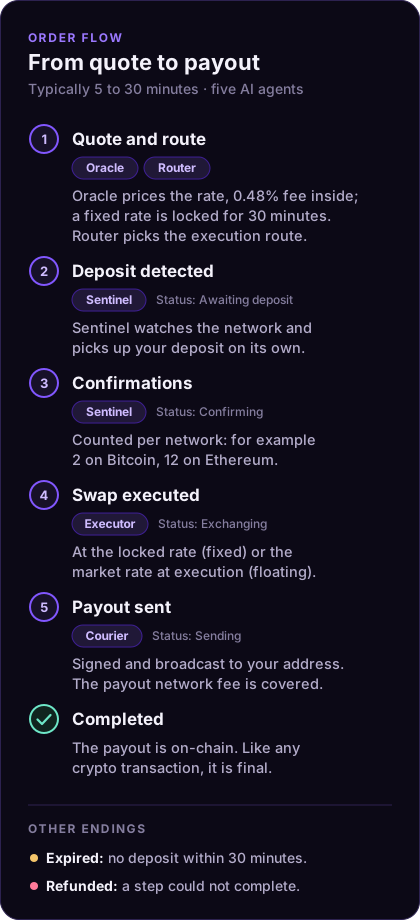
A crypto swap on Ghostex runs in five steps. Oracle quotes the rate and, on a fixed order, locks it for 30 minutes. Router picks the execution route. Sentinel detects your deposit and counts its confirmations. Executor performs the exchange, and Courier sends the payout to your address. If a step cannot complete, the deposit is refunded automatically. A typical swap takes 5 to 30 minutes, depending on network confirmations.
Why do AI agents run the swap instead of a desk?
A traditional exchange runs on people: a trading desk, a compliance team, a support queue. Ghostex replaces that with a mesh of five specialised AI agents. Each one owns a single step of your swap, applies the same rules to every order, and runs around the clock. In normal operation there are no humans in the loop, no trading desk and no review queue. You can meet the five AI agents that run Ghostex on the About page; this guide follows one swap through them, step by step.
This is not decoration. Automation is what makes no-KYC practical: a machine does not need to know who you are to quote a rate, count confirmations or broadcast a transaction. Take the people out of the middle and the identity step they relied on goes with them.
Step 1: the quote and the 30-minute rate lock
Oracle, the pricing agent, aggregates market data across venues and produces the rate you see when you create an order, with the flat 0.48% fee already included. For a fixed rate, Oracle sets the number that gets locked for 30 minutes. If the exact quoted amount arrives inside that window, you receive the quoted amount, even if the market moves. For a floating rate, it keeps pricing until the moment of execution. If no deposit arrives within the window, the order expires and nothing is charged.
Step 2: the route
Router, the liquidity agent, works out how to actually get from what you send to what you receive. It finds the best execution path for your pair across available liquidity. It also handles pairs and networks that are temporarily paused. If a route is unavailable before execution, Router is why the order is refunded in the same asset rather than left hanging.
Step 3: your deposit and its confirmations
Sentinel, the chain-watch agent, is the eyes on the blockchain. It detects your deposit, counts network confirmations and flags anything unusual. On Bitcoin, a transaction has one confirmation once it is included in a block. It gains one more with each block added after it (see the Bitcoin developer guide on verifying payments).
Different networks need different confirmation counts, for example 2 on Bitcoin, 12 on Ethereum, 20 on Tron and 32 on Solana. Sentinel counts them for you and shows the progress on your order page, where you can track your swap by order ID. When a deposit is late, outside the limits or a different amount than quoted, Sentinel is the agent that notices and raises the exception.
Step 4: the exchange
Once Sentinel clears the deposit, Executor, the settlement agent, runs the exchange. A fixed order executes at the locked rate, and a floating one at the market rate at execution. It is also the agent that decides a refund when a swap cannot complete: rather than force a bad execution, Executor prepares the deposit to go back. That decision is automatic and rule-based, not a judgment call by a person.
Step 5: the payout
Courier, the payout agent, signs and broadcasts the final transaction: the payout to your destination address or, if the swap could not complete, the refund. The network fee for sending your payout is covered by Ghostex and already reflected in your quote. When Courier broadcasts, the order reaches its end state, and where the network has a public explorer, your order page links to the transaction. Like any crypto transaction, it is final once it is on-chain.
What if a step cannot complete?
Because each edge case has an owner agent and a rule, exceptions do not become support tickets. A late deposit, an amount outside the limits, a paused pair or a network interruption each resolve on their own: the order completes, or the deposit is refunded automatically. If the issue is the amount, here is why you should send the exact quoted amount.
The refund is sent to your refund address or back to the address you paid from. It arrives in the same asset and on the same network, minus the network cost of sending it back. Every confirmed deposit ends one of two ways: delivered, or refunded automatically. Refunds run through Sentinel, Executor and Courier without you asking. The full flow is in how automatic refunds work.
The statuses on your order page
Your order page shows where the swap is. A successful swap moves through these statuses in order:
- Awaiting deposit: the order is open and waiting for your funds.
- Confirming: Sentinel has seen your deposit and is counting network confirmations.
- Exchanging: Executor is swapping at the locked or market rate.
- Sending: Courier has signed and broadcast your payout.
- Completed: the payout is on-chain.
Two other statuses are also final:
- Expired: no deposit arrived within 30 minutes, so the order closed and nothing was charged.
- Refunded: the swap could not complete, and Courier returned your deposit in the same asset and on the same network, minus the network cost of sending it back.
| Time | Agent | What the order page shows |
|---|---|---|
| 14:02:08 | Sentinel | Deposit detected, 0 of 12 confirmations |
| 14:04:56 | Sentinel | Deposit confirmed, 12 of 12 |
| 14:04:57 | Executor | Executing ETH to BTC at the locked rate |
| Later | Courier | Payout broadcast to your Bitcoin address |
| Later | - | Completed |
Summary: how the five agents run every order
Oracle prices, Router plans, Sentinel watches, Executor acts and Courier delivers, then the loop closes and the next order begins, at three in the morning as at midday. The agents need only the pair, the amount and your addresses. They never ask for your name, email, phone number or ID, because there is no account and no identity check of any kind. People build and maintain the system, and step in only where the law requires it, for security, or to recover from a technical failure.
See the steps in action by starting a BTC to ETH swap, picking one of the popular swap pairs or browsing the supported assets page. To go further, learn what no-KYC really means, or read the FAQ for more on the agents.
This guide is general information about how crypto swaps work, not financial advice. Product facts follow the Terms and the Privacy policy.
Keep reading
More guides
What is a no-KYC crypto exchange?
No account, no ID, no identity check. Here is what no-KYC actually means, and how an exchange can run a swap without ever asking who you are.
Read the guideHow automatic refunds work
If a swap cannot complete, the deposit goes back on its own. Here is where it goes, how much you get back, and when a refund address is required.
Read the guideFixed vs floating exchange rates
A fixed rate locks your quote for 30 minutes. A floating rate settles at the market rate when the swap executes. Here is how each behaves, and when to choose which.
Read the guide